
Permits
Where Can a Dumpster Actually Go in Manitowoc?
The paperwork is simple. The older streets and the winter are the complicated parts.
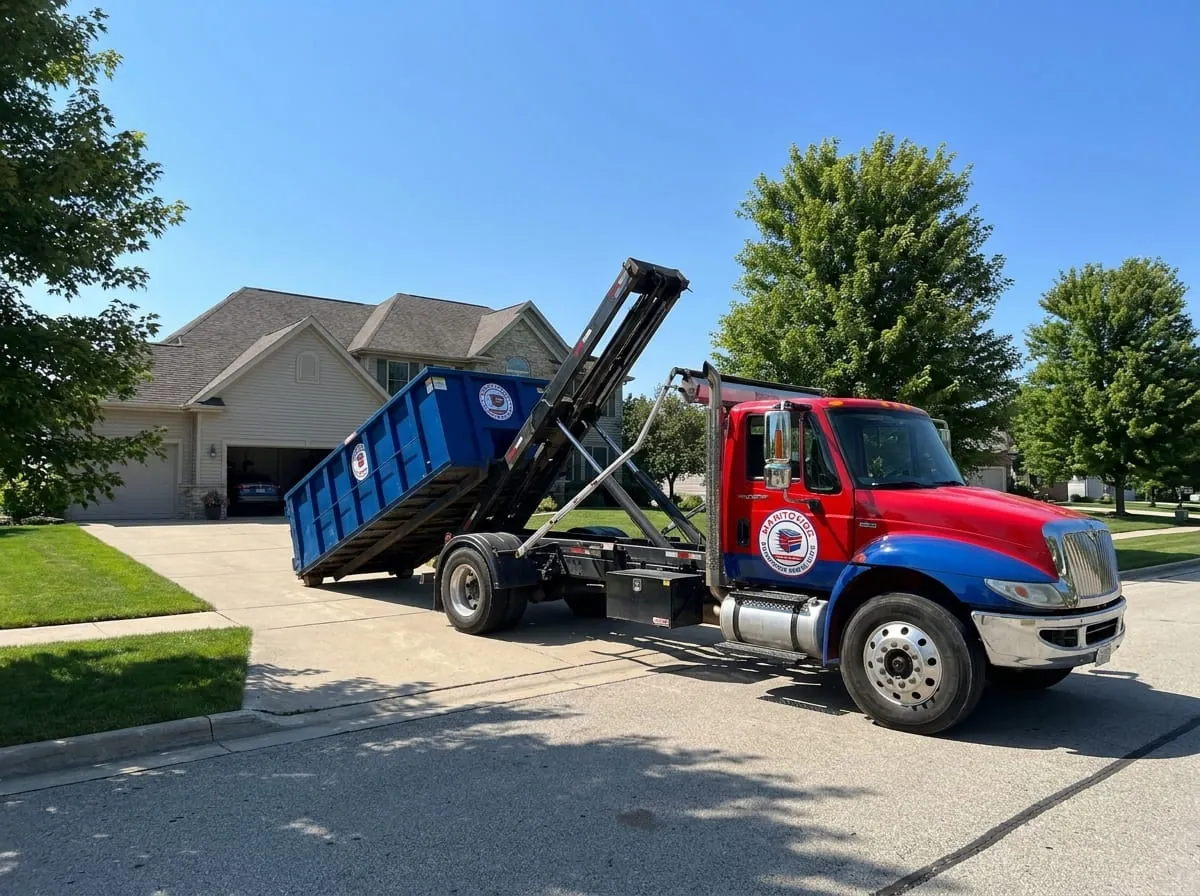
The short answer
If a temporary roll-off is going on your own driveway or private lot for the duration of a project, you are almost certainly fine without a placement permit.
If it has to sit on a public street, ask first — and ask us, because we work across seventeen communities in five counties and can point you at the right office.
The complications here are not paperwork. They are the older street grid near downtown, and the winter.
Private property: a temporary roll-off
A driveway, a private parking area, a fenced site or a commercial lot you own or lease is private property, and a temporary container placed there for a project is not what municipal placement rules are aimed at.
Two caveats that are not placement permits but behave like them:
- The underlying work usually needs a building permit.
- If the property is a rental or has an association, their permission is not optional. Get it before you book rather than after.
⚠️ Older lots, alleys and detached garages
This is the local constraint that decides more jobs here than the paperwork does.
A large part of Manitowoc, and of Two Rivers and Kewaunee, is older housing on narrow lots: a short drive, a detached garage set well back, and often an alley behind. That arrangement is fine for a car and awkward for a twenty-two foot container on a truck that needs room to tip.
What matters:
- Driveway width, at its narrowest point, not its widest.
- Length of clear run — a 20 and a 30 yard are both twenty-two feet of container, and the truck needs more than that again to set it down.
- Whether the garage is attached or detached, and whether the drive runs past it.
- Whether there is an alley, and whether it is a legal and practical approach.
- Fences, gateposts and mature trees on the approach.
Tell us the numbers and we will recommend honestly. ⭐ On a tight older lot a 10 or 15 yard with a swap is very often the right answer, and it is cheaper than a wasted delivery.
Street placement: ask first
Rules for containers in the roadway are set by each municipality individually, and we would rather you asked than assumed. Arrange it properly rather than hoping, and keep the period short.
⚠️ One local point that matters more here than in most markets: a container on the street in winter is in the way of snow clearance. On a lake-effect shoreline that is not a theoretical conflict — plough crews take it seriously and so should you. If the work can wait for spring, it usually should.
⚠️ Lake-effect snow and winter placement
We deliver all winter. A few things make it work:
- Clear and salt the placement spot before delivery. A truck cannot set a container down accurately on sheet ice.
- Clear a path to it too, or loading becomes miserable and material ends up stacked beside the container rather than in it.
- Tell us about any grade. A slope that is fine in September is a different question with ice on it, and a loaded container on an icy incline is a genuine safety matter.
- ⚠️ Keep snow out of the container. Lake-effect bands can drop a lot of snow quickly, and snow and ice are weight you pay for.
- Material freezes together. Wet carpet, soil and plaster left open become one solid mass that has to be broken out at the other end.
- Book shorter windows in winter — fill it and let us take it.
Frost, thaw and what the ground carries
- Frozen ground carries a loaded container well. Deep winter is actually a good time for placement on gravel or grass.
- ⚠️ Spring thaw is the worst time. Ground that was solid in February turns soft, and an asphalt driveway is at its most vulnerable while the base underneath is still saturated.
- Tell us the surface — asphalt, concrete, gravel or grass. It changes what we do.
- We put timber boards down on every delivery regardless, and more of them on asphalt in spring.
Overhead wires and the tipping arc
Easy to forget, because the container is low and the problem is high. A roll-off truck raises the bed steeply to set a container down and to pick it up, and needs clear height well above the container itself.
- Overhead service wires to the house — common on the older streets, where services often run from poles in the alley
- Low branches, which in this climate are often heavy with snow or ice
- Basketball hoops, porch roofs and carports near the placement spot
Tell us about anything overhead. After driveway width it is the most common cause of a wasted trip.
Five counties, and what changes
Placement rules are municipal, but the facilities change with the county:
- Manitowoc County — Manitowoc, Two Rivers, Mishicot, Valders, Reedsville, Whitelaw, St. Nazianz, Francis Creek, Cleveland, Kellnersville, Maribel, and part of Kiel.
- Calumet County — Brillion, New Holstein, and part of Kiel.
- Kewaunee County — Kewaunee, Algoma.
- Brown County — Denmark.
- Sheboygan County — Howards Grove.
⚠️ Kiel straddles the Manitowoc and Calumet county line, so confirm which side your address is actually on.
What does not change anywhere in the state: Wisconsin's landfill bans, the six-inch brush rule, and the requirement that your hauler holds a DNR transportation license with the number displayed on the truck door.
Ordinances vary by municipality and change over time, and this service area spans five counties. The above reflects how these jurisdictions generally operate at the time of writing. For anything consequential, confirm with your own city, village or county office.
Need a container in Manitowoc?
Call and describe the job. Three minutes on the phone gets you a size recommendation, a flat rate and a delivery window — and we will tell you if a smaller, cheaper container is the right answer.
Call (920) 717-3199